
Sleep & Snoring · Editorial
Your Snoring Keeps Getting Louder — Because Everything You've Tried Ignores What's Actually Causing It
We're publishing this because, after years of hearing the same story from exhausted couples, we believe you deserve a clearer — and more honest — answer about why nothing you've tried has stuck.
It usually starts small. A little snoring. Then a bit louder. Then your partner is nudging you awake at 2 a.m., sleeping with earplugs in, or quietly moving to the guest room to survive the night.
Maybe you feel it too — the mornings where eight hours somehow felt like three, the mid-afternoon fog, the alarm that seems crueler every year.
Here's the part almost nobody tells you: for a lot of people, the loud part of snoring isn't coming from where you think — and that's exactly why the usual fixes never stick.


What Loud Snoring Is Quietly Costing You
It's rarely "just noise." Night after night, it adds up — for you and for whoever shares your walls.
Exhausted mornings
Noisy, broken sleep is rarely deep sleep. You clock the hours but wake up feeling like you barely slept.
The 2 p.m. fog
Poor nights catch up in the afternoon: focus slips, patience gets shorter, coffee stops helping.
A worn-out partner
You may sleep straight through the noise. The person next to you doesn't — and their exhaustion becomes yours.
The guest-room drift
First it's earplugs. Then separate bedtimes. Then separate rooms. The distance builds silently.
It grows with age
The muscle tone that keeps things quiet naturally declines over the years. Left alone, tonight's snoring is rarely as loud as it will get.
None of this tends to fix itself. Which is why it's worth understanding what's actually making the noise.
What Happens If You Keep Ignoring It
Not a scare tactic — just the pattern couples describe to us again and again.
-
Year 1
The "it's just snoring" phase
You brush it off. Your partner mentions it, you try a nose strip, nothing changes, everyone moves on. You blame stress, work, age.
-
Year 2–3
The earplug era
The noise is now a nightly fixture. Your partner sleeps with earplugs, you both wake up tired, and the joke about your snoring has quietly stopped being funny.
-
Year 5
Separate rooms
The guest room slowly becomes "their" room. Nobody decided it — it just happened, one bad night at a time.
-
Year 10+
The new normal
Sleeping apart, waking up tired, a noise everyone has given up on. By now the habit itself is the hardest thing to undo.
If you recognize yourself somewhere on this line, the good news is simple: you can step off it at any point.
The mechanism
So What's Actually Making the Noise?
Here's what surprises most people: the root of loud snoring usually isn't your nose. It isn't your sleeping position. It isn't even your weight — though that can make it worse.
It's the muscles under your chin and around your throat.
When you drift into deep sleep, those muscles relax. In some people — and this tends to increase with age — they go so slack that the soft tissue around them starts to vibrate as air passes over it. That vibration is a big part of what you (and everyone in the house) hear as snoring.
Slack, relaxed tissue = rattling, noisy airflow. Toned muscles = quieter airflow. That's the mechanism in one line.
And that muscle tone is exactly the piece every mainstream fix skips.
An honest note: loud snoring with gasping, choking, or long pauses in breathing can be a sign of a medical condition like sleep apnea. If that sounds like you, please talk to a doctor first. Somnair is not a medical device and is not a treatment for sleep apnea — it's built for the everyday noise that keeps a household awake.
Why the Usual Fixes Keep Missing
Most of them aim at the wrong spot entirely.
Nasal strips
They open your nostrils. Helpful if your nose is the whole story — but the loud, rattling kind of snoring usually starts lower down.
Mouthguards
They push your jaw forward and hope. Uncomfortable, pricey to fit properly — and still not the part that's actually vibrating.
Earplugs
They protect your partner's ears, not their sleep — and they do nothing about the snoring itself.
Side-sleeping tricks
Position hacks and wedge pillows can buy a quieter hour. Then you roll onto your back, and the noise is right back.
None of them touch the one thing they all skip: the muscle tone under your chin.
Until now.
Introducing
Meet Somnair — Muscle Toning for Quieter Nights
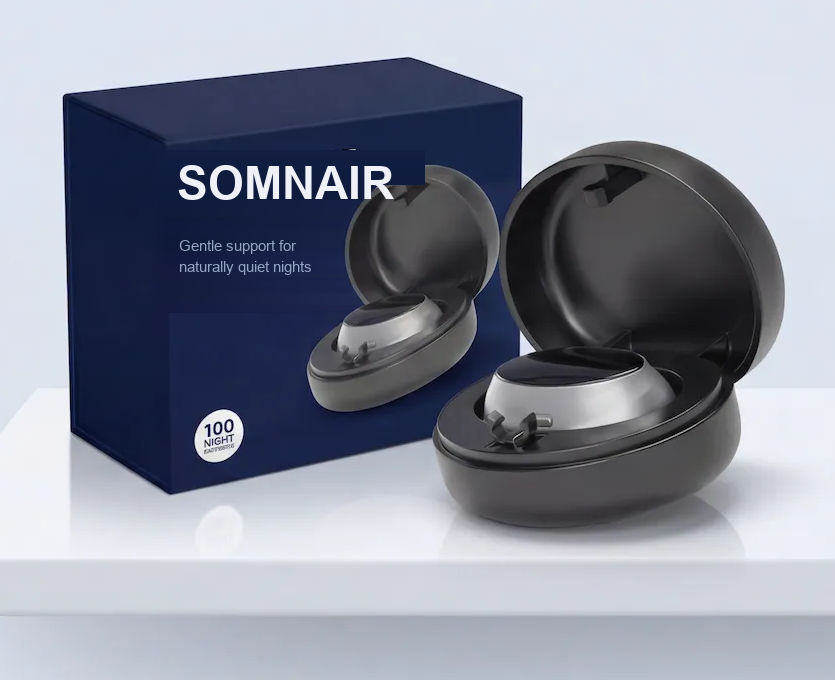
Somnair is a small device you wear under your chin for about 15 minutes before bed. It uses gentle EMS (electrical muscle stimulation) — the same broad principle behind fitness muscle-toning devices — to give the muscles under your chin gentle, painless activation.
The idea is simple: more tone in that area means less slack tissue, less vibration, and a quieter night — for you and for whoever shares your bed.
- ✅No mask, no hose, no mouthpiece — nothing to sleep in
- ✅About 15 minutes a session, then you sleep normally
- ✅Silent, hands-free and painless — you control the intensity
- ✅Built for everyday snoring — not a medical treatment
$396$149
$247 OFF today · Free US shipping · 100-night money-back guarantee
Get Somnair — $247 OFF Today →
100 nights to try it. If your nights aren't quieter, get every dollar back.
How It Works — About 15 Minutes, Then You Sleep
No fitting appointment, no learning curve.
-
Step 1
Place it
Click a fresh gel patch onto the device and position it under your chin. No straps, no headgear, nothing in your mouth. The skin-friendly adhesive keeps it in place.
-
Step 2
Run a session
Turn it on for about 15 minutes while you read or wind down. Pick one of 3 intensity levels — it feels like a soft, rhythmic pulse. No pain, no noise.
-
Step 3
Stay consistent
Muscle tone builds with repetition, night after night. Give it a fair run — most people judge it over a few weeks, and the 100-night guarantee gives you room to do exactly that.
What the First 100 Nights Can Look Like
Everyone starts from a different place, so treat this as a map — not a promise.
-
Nights 1–14
The routine settles in
The 15-minute session becomes part of winding down. In many households, the partner is the first to notice a change in the noise level.
-
Weeks 2–4
Quieter stretches
Quieter nights start showing up more often — and the earplugs on the other nightstand start getting a rest too.
-
Months 1–2
The new rhythm
For many users this is when quieter nights become the norm rather than the exception — and the earplugs start collecting dust on the nightstand.
-
Months 3+
Make it yours
The 15-minute session stays part of winding down. Keep the cadence that works for your own nights — by now, it's simply your routine.
A personal note
About the Person Sleeping Next to You
Snoring is never just one person's problem. It belongs to whoever lies awake next to it — checking the clock at 3 a.m., nudging, waiting, finally giving up and moving to the couch.
They didn't leave the bedroom because they stopped loving you. They left because nobody can run on three hours of broken sleep forever.
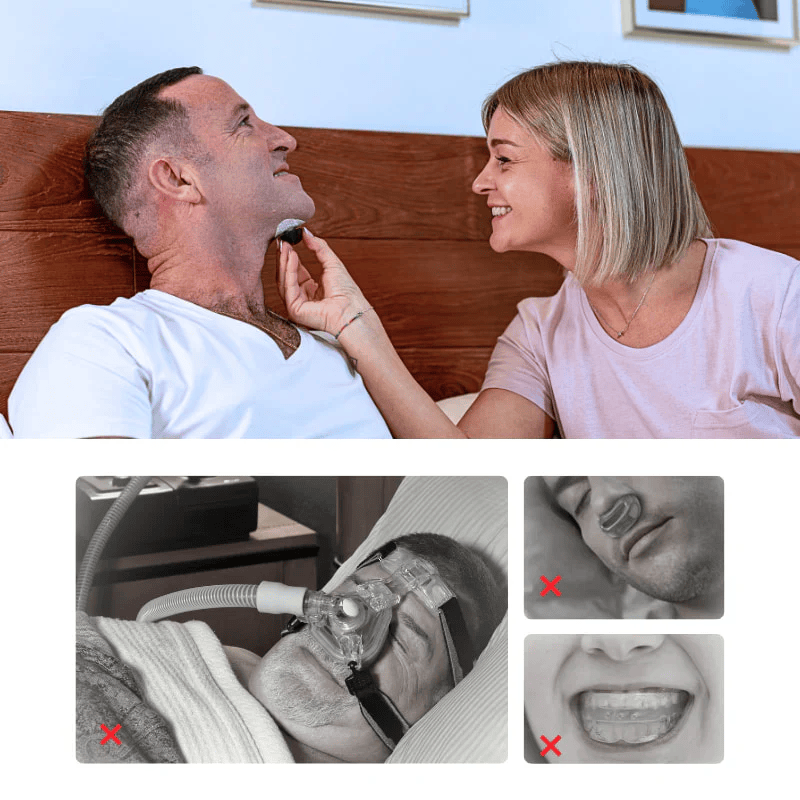
When customers write to us, the happiest messages are rarely about the snorer. They're about the other side of the bed — being back in the same room, retiring the earplugs, seeing each other rested again.
If you won't try it for yourself — try it for them. They've waited long enough.
You Risk Absolutely Nothing
Try Somnair for 100 nights. Not 7, not 30 — one hundred. Building a new routine takes time, and we want you to judge it over a fair run, not a rushed weekend.
If your household isn't sleeping quieter, email us and we'll refund your purchase in full. No questionnaire, no hoops, no restocking fee.
Questions People Ask Us Every Day
Straight answers, no fine print surprises.
Does it hurt? Will I feel the pulses?
You'll feel a gentle, rhythmic pulse — most people describe it as unusual for the first minute, then easy to ignore. It's designed to be painless, and you control the intensity across 3 levels.
Will it stay in place?
Yes. The device clicks onto a skin-friendly adhesive gel patch that's made to stay put for the whole session, even if you move around while winding down.
How long until I notice a difference?
Muscle tone builds with repetition, not overnight. Some households notice quieter stretches early; for others it takes a few weeks of consistent sessions. That's exactly why the guarantee runs 100 nights — enough time for a real answer.
Is Somnair a medical device?
No. Somnair is a wellness device built for everyday snoring — the noise. It does not diagnose or treat sleep apnea or any medical condition. If you snore loudly and gasp, choke, or stop breathing during sleep, please talk to a doctor first.
I've tried literally everything. Why would this be different?
Almost everything else aims at your nose, your jaw, or your partner's ears. Somnair works on the one thing those all skip — the muscle tone under your chin, which is where a lot of the noise actually comes from.
Why haven't I heard about this approach before?
EMS muscle toning has been familiar in fitness and physio settings for decades — applying it to the under-chin area for snoring is simply newer. You don't have to take anyone's word for it: give it a fair 100-night run and judge it on your own nights.
What if it doesn't work for me?
Then it costs you nothing. Email us any time within your first 100 nights and we'll refund the purchase in full — no questions, no hoops.
Tonight Can Be the Last Loud Night You Ignore
You can keep doing the earplug shuffle and hoping it fixes itself — the pattern says it won't. Or you can spend 15 minutes tonight on the muscle everything else skips, with 100 nights to prove it to yourself.
Try Somnair Risk-Free for 100 Nights →
$247 off today · Free US shipping · 100-night money-back guarantee
This product is designed for comfort and to help reduce snoring-related noise. It does not diagnose, treat, cure, or prevent sleep apnea or any medical condition. If you snore loudly, gasp for air during sleep, or feel exhausted no matter how long you sleep, those can be signs of sleep apnea — please talk to a doctor.